The Atlanta Airport Debacle
The Firing of Airport General Manager Miguel Southwell
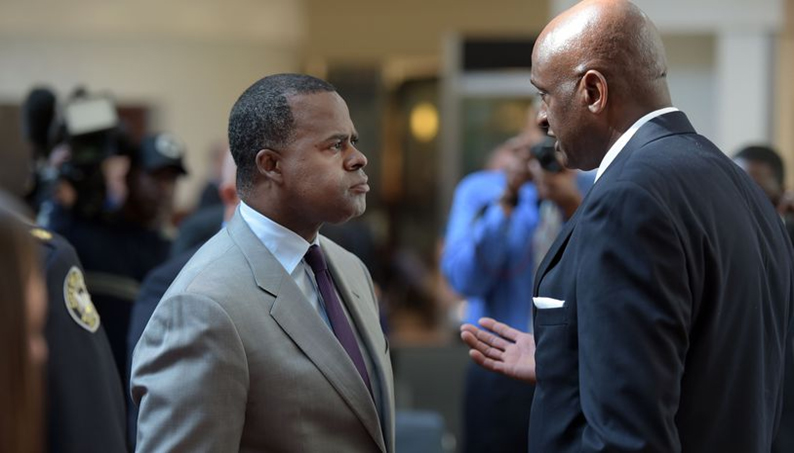
In May of 2016 Mayor Reed fired Miguel Southwell, the general manager of Atlanta’s Hartsfield Airport. Southwell accused Reed of firing him because he pushed back on Reed’s interference in the awarding of Atlanta airport vendor contracts. According to a letter sent to the Mayor, by Southwell’s attorneys, Reed’s senior staff monitored Southwell’s staff’s emails and took action to cause contracts to be awarded to companies other than the highest ranked bidder.
At the time Reed stated that Southwell was making false statements against him to salvage his reputation. "I could have pressed charges against him if I had chosen to do so" and “Miguel Southwell is fortunate I don’t destroy his career” Reed is quoted as telling Channel 2 Action News’ Aaron Diamant. But according to Southwell’s lawyers, “[t]he truth is that Mayor Reed fired Mr. Southwell because he was unwilling to bend the knee to the Mayor’s ‘Friends and Family’ contracting program”.
Three months later in September of 2016, Reed and Southwell issued a joint statement claiming that in the “interests of complete transparency” it was all a big misunderstanding and they “they both now agree that neither of them engaged in any civil or criminal wrongdoing” and “that their differences were more a matter of style than substance.” When asked if any money changed hands, the Mayor’s office reported that no payments were made to Southwell. In December of 2016, however, at the request of the Reed Administration, the Atlanta City Council approved a $85,516 settlement in which council members were told the funds would pay for career counseling, job placement assistance and health insurance for Southwell. The Reed administration told council that the money represented the full settlement with the fired airport general manager.
Nevertheless, it was later reported that the City Attorney and the lawyer hired by the City had orchestrated another secret payment to be paid to Southwell in the amount of $147,000 which was not revealed to the City Council at the time that body approved the payment of $85,516 in compensation to Southwell. City Council President Felicia Moore later proclaimed that the City Council was lied to.

Felicia Moore
In subsequent documents uncovered by the AJC through open records requests it was revealed that the $85,516 approved by the City Council actually went to Southwell’s lawyers for legal fees. Southwell’s lawyer, Lee Parks, was quoted as telling the AJC and Channel 2 Action News:
“They did not want to issue the attorney fee check to me or the firm due to the fact I had frequently sued the city and they believed the payment would be perceived by the public as a settlement of a civil claim rather than a simple agreement on severance where they paid for our work helping Miguel move forward with his career. So, the fee bill was sent under my partners name at their request.”
In essence, the City of Atlanta was defrauded of $85,516 which was paid under false pretenses for Southwell’s career counseling, job placement assistance and health insurance when in actuality the funds covered Southwell’s legal fees to attorney Lee Parks. Former City Councilwoman Mary Norwood was quoted by the AJC as stating that the disguising of the true purpose of the payment was part of a “pattern of corruption” and in a statement she issued she said: “Everyone who participated in this conspiracy and fraud must be held responsible and it is imperative that our Mayor denounce this action and those who participated in this scheme. Anything less is an abdication of ethical leadership.” In the same AJC article former DeKalb County district attorney and criminal defense lawyer, J. Tom Morgan, was quoted as saying: “it stinks to high heaven” and that two lawyers aided Reed “in playing a fast one” on the council.
After the secret agreement to pay Southwell $147,000 was reached in August of 2016, problems arose when Southwell, two months after execution of the agreement, had not received any payments. Although the Settlement Agreement that Southwell signed with the City specified that he was to receive $147,000 in eight equal monthly installments no mention was made as to who would be making the payments. In later emails obtained by, and reported on by the AJC, it was revealed that the payments were to be made by Carter, a real estate developer and vendor to the City at the Atlanta airport and who had major business ventures pending with the City and who later purchased and developed Turner Field from the Atlanta Fulton County Recreational Authority. Carter’s CEO is Scott Taylor. Southwell’s attorney, Lee Parks, wrote to the City’s attorney, outside hired lawyer, Mark Trigg, in October of 2016 that the City was to make arrangements for the payments. "Mark this is getting out of control. Scott Taylor now wants a contract that absolves him from payment. We have a contract with the city. It is your obligation to work with whoever is going to make the payments, without our having to separately contract with them.” It is unclear how the payment dispute with the third-party payor, Carter, was resolved. According to the AJC, Carter did confirm that it hired Southwell as a consultant for work related to airports outside Georgia after Reed fired him as Atlanta’s airport general manager.
At bottom, the sum total of the events is that Southwell was paid a six-figure settlement under a Settlement Agreement between him and the City, which was funded or partly funded by the City and partly by a private third party with pending business deals with the City. The City Council unwittingly approved a contribution of $85,516 under false pretenses made by the Reed administration. The net effect of the Settlement Agreement was to purchase Southwell’s silence regarding his initial accusations that Reed and his senior leadership were interfering in the award of airport vendor contracts in favor of preferred vendors who were not the highest ranked bidders.
DOJ Investigation - Unconscionable and Possibly Unethical Payments to Associated Law Firms
The City spent $1.7 million on attorneys in relation to Reed's firing of former airport general manager Miguel Southwell in a dispute that became an early focus of the federal Department of Justice investigation into city hall corruption. Reed’s former law firm, Paul Hastings, invoiced the City more than $667.000 on the Southwell matter in the last three weeks of June 2016. In addition, the City used the law firms of Baker Donelson and Greenberg Traurig to handle Justice Department subpoenas for City records associated with a host of investigations into various aspects of City corruption during the Reed administration. The City continued to pay outside law firms for legal services rendered in connection with the investigations stemming from activities of the Reed administration throughout the tenure of his successor, Mayor Keisha Lance Bottoms. By August of 2018, the AJC was reporting that the legal tab for over 100 attorneys deployed and various times between 2016 and that date totaled over $7.5 million.
Paul Hastings, LLP

Kasim Reed started his legal career after graduation from Howard University Law School at the law firm of Paul, Hastings, Janofsky & Walker LLP, now known as Paul Hastings, LLP. Starting in 2014 and through 2017 the City of Atlanta paid Reed’s former firm $2.2 million in monthly flat rate invoices of between $25,000 and $125,000 per month for work that was vaguely described as “litigation consultation” and “legal research”. The invoices didn’t identify the lawyers who performed the work and contained no detail of the work performed. This arrangement is highly unusual in the legal profession, particularly when it involves legal work for a public entity.
On the heels of the Miguel Southwell controversy came a Federal Aviation Administration (FAA) investigation into how the City was spending federal aviation dollars. FAA regulations prohibit the use of airport revenue for expenses other than the airport’s capital or operating costs. At the center of the investigation were the monies the City paid to Paul Hastings, and two other law firms, but particularly the flat fee billing arrangements between Paul Hastings and the City.
The FAA first got interested in the City’s uses of airport revenues in July of 2018 when it issued its first request for documents to the City citing AJC news reports that the City had spent at least $5.8 million on attorneys responding to the federal corruption probe. Included in this figure was $1.7 million in attorney’s fees spent on Reed’s controversial decision to fire Southwell. According to the AJC reports at the time, the Reed administration withheld and obscured the extent of the spending on lawyers during the last six months of the Reed administration.
Cathy Hampton

At the center of much of the controversy over legal fees was Reed’s City Attorney, Cathy Hampton. Hampton was accused by Southwell of monitoring his emails and those of his senior staff members without his knowledge or consent. Hampton, a $274,000 a year City employee, who directed an in-house staff of 80+ attorneys also hired dozens of outside lawyers to perform legal work on behalf of the City. One of those firms was Paul Hastings, whose engagement partner was William K. Whitner.
Hampton was the city employee who approved the payment of $2.2 million in questionable flat-fee monthly billings from Paul Hastings. She was selected as the City Attorney by a panel of individuals to which William K. Whitner served as a member. Whitner and Hampton were appointed by Reed to serve on the Atlanta Fulton County Recreation Authority Board of Directors, and continue to serve on that Board, on which Whitner now serves as Board chair. That authority later sold the old Braves Stadium to Carter, the company who hired Miguel Southwell in a secret hush money agreement after he was fired by Reed as airport general manager. Whitner and Hampton were involved in crafting and approving the deal with Southwell and his lawyer.
Shortly, after announcing that she was resigning her position as City Attorney, in 2017, six months before Reed was to leave office, Hampton sent two $45,000 invoices to the Paul Hastings law firm, to the attention of William K. Whitner, on behalf of her consulting company, HCG Consulting Group, LLC. There is, and was, no such company registered with the Georgia Secretary of State by that name, however, the tax ID number on the invoices matched another company owned by Hampton called Hampton Consulting Group, LLC. The return address on the invoices is the current address of Hampton’s law practice. The only indication as to what work the invoices represented was a reference line that read: “Transition Services”.
Paul Hastings passed through the $90,000 in invoices from Hampton to the City for payment. The City paid the invoices after Hampton left employment upon approval by her successor, then City Attorney, Jeremy Berry. After the FAA launched an initial inquiry into potential revenue diversion, it was determined that the funds were wrongly paid out of airport funds and the money was later paid back to the City by Paul Hastings. The question remains, however, as to whether Hampton performed any work for the $90,000 in payments she received from Paul Hastings, or whether the payment served some other purpose.
Jeremy Berry

After Hampton left employment at the City as City Attorney, Jeremy Berry took over as her successor after Reed named him as the new City Attorney. When Paul Hastings submitted Hampton’s invoices to the City for payment, approval was given by Berry. In March of 2018 the GBI, at the request of Georgia Attorney General, Chris Carr, opened a criminal investigation into the City’s response to open records requests made by the AJC. Berry was swept up into the investigation related to his response to AJC requests for legal bills submitted by the law firm, Baker Donelson. The AJC accused Berry of creating documents to appear as invoices from Baker Donelson when in fact they were summaries or compilations of actual invoices.
Prior to his appointment as the new City Attorney, Berry was a partner at the Dentons law firm. He had also served as Reed’s campaign committee chairperson. In the latter role he was responsible for compiling and submitting campaign disclosure reports regarding expenditure of campaign donations to Reed’s campaign for Mayor. It was in this capacity that Berry has recently come under the spotlight for his role is submitting campaign disclosure reports that the DOJ is investigating for wire and mail fraud.
Berry was subpoenaed to testify before a federal grand jury in April of this year. Reed’s campaign has fought the subpoena seeking Berry’s testimony on the grounds of attorney-client privilege over the last several months. They seek Berry’s testimony concerning campaign expenditures on Reed’s personal purchases of jewelry, resort travel, lingerie and furniture from campaign funds. The details of the dispute are outlined in surprising detail in an appellate court decision recently made public on June 25, 2021.
The ruling denies Reed’s campaign’s request seeking to prevent Berry from appearing before the grand jury and requires Berry to appear and to testify to certain specific questions about campaign finances. Most importantly for Reed’s future is the fact that the ruling indicates that whatever expenditures were made Berry has verified in interviews with federal investigators that Reed was fully aware of them and sanctioned the filing of campaign reports omitting the disclosure of personal expenditures. The appellate court found that these revelations by Berry were potentially indicative of fraud and that his attorney-client defense had no validity.
Sweetheart Deals to Insider and Conflicted Vendors

At the same time that Paul Hastings was engaged in the unusual flat fee billing arrangement it was also engaged in a more traditional hourly rate fee arrangement with the City. Under this arrangement the firm handled other City legal matters including work at the Atlanta airport. What was outside the norm, however, was the fact the one of the Paul Hastings lawyers billing on the airport work was Dennis Sean Ellis, a Paul Hastings partner, who was a close associate and former law school classmate of Kasim Reed. Reed and Ellis were classmates in the 1995 graduating class at Howard University Law School and both started their legal careers at Paul Hastings.
Ellis and celebrity chef G. Garvin founded LowCountry Restaurants, a concessionaire on Concourse A. LowCountry was awarded a concession contract in December of 2011 which was challenged by the losing bidders. Paul Hastings submitted legal bills to the City for the work it performed on the legal challenge. Ellis invoiced the City for the work he performed as a Paul Hastings employee, even though he was financially interested in the outcome of the challenge and even though Paul Hastings had signed an engagement letter certifying that it had no conflicts of interest for the work it was performing on the airport.
State bar rules prohibit a lawyer from representing a client if there is a significant risk that the lawyer’s own interest will materially and adversely affect the representation of the client. This prohibition combined with the fact that Paul Hastings had signed a letter of engagement certifying that the firm had no conflicts of interests raised serious ethical issues in the City’s procurement of legal services on airport matters from Paul Hastings.
Welcome to WordPress. This is your first post. Edit or delete it, then start writing!